Imagine you and your partner enjoying a candlelit dinner and your green stone ring turns deep red. No, it’s not magic. It’s Alexandrite and it’s been hiding a second identity that you may not have known about. But before we dive into the fascinating qualities of June’s Birthstone – Alexandrite, here are some quick facts!
Quick facts
- Mineral: Chrysoberyl (color-change quality)
- Mohs hardness: 8.5 (extremely durable)
- Color: Green in daylight ; Red or purple under warm light
- Chakras: Heart Chakra and Third Eye Chakra
- Zodiac: Gemini and Cancer
- Birthstone: June (alongside Pearl and Moonstone)
What is the June Birthstone Alexandrite Meaning?
Your birthstone is supposed to represent you. Alexandrite goes a bit further – it behaves like you. Different in every room, under every light. Most people can name a birthstone. Very few can say theirs does something. Alexandrite does something.
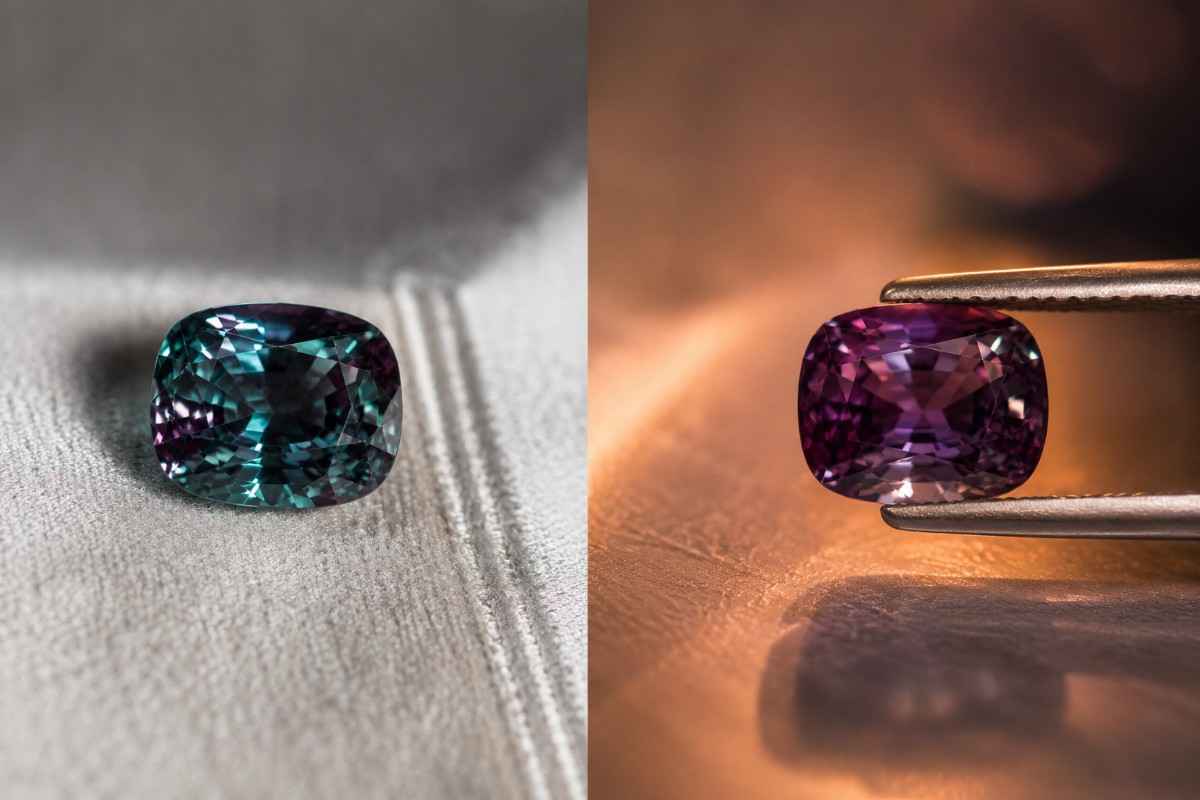
It’s the June birthstone that changes color from vivid green under sunlight to deep red or purplish-crimson under warm light. Alexandrite is a variety of the mineral chrysoberyl. What makes it extraordinary isn’t just rarity, it’s the chemistry. You’ll read about this in the next section.
It was first discovered in Russia’s Ural Mountains in 1830, reportedly on the birthday of Tsar Alexander II, which is how it got its name. The gem quickly became the talk of the town. Its red and green colors resembled the Russian Imperial Guard’s military colors, making it a stone of national pride almost overnight.
The Dueling Identity — Why Alexandrite Has Two Souls
There is a moment every alexandrite owner knows. Imagine yourself wearing the stone all day and you can see that green, calm and composed color mounting on the piece of jewelery. Then evening comes. The lights change. And without warning, your stone changes with them. The green is gone and now in its place you can see a deep red, sometimes violet or sometimes a color that sits somewhere between the two and doesn’t have a clear name.
The fact is you didn’t change the stone. The stone changed itself. This is what makes alexandrite unique in the gemstone world. It doesn’t have one identity. It has two and it lives between them fully, unapologetically, depending entirely on the light it’s standing in.
What Causes the Color Change in Alexandrite?
The science behind it is almost as dramatic as the stone itself. Alexandrite belongs to the chrysoberyl mineral family. What separates it from every other member of that family is the presence of chromium in its crystal structure. Chromium is a chemically restless element. In emeralds, it produces green, in rubies, it produces red but in alexandrite, it does both.
Natural sunlight is rich in blue and green wavelengths. Alexandrite absorbs the red end of that spectrum and reflects green back to your eye. Incandescent light like candlelight, tungsten bulbs, and warm indoor lighting is rich in red and yellow wavelengths. Now the stone absorbs the green end and reflects red.
Same stone with the same amount of chromium in it but reflecting different colors under different light. Gemologists call this the “alexandrite effect” and it’s considered the most dramatic color change of any naturally occurring gemstone on earth. A fine alexandrite showing strong, clean color shift in both directions is rarer than a diamond of comparable size. Most people have never seen one in person.
What you need to understand is this, the color change isn’t a flaw or an anomaly. It is this trait only which makes this gemstone so different from others.
Why This Makes It the Perfect Gemini Birthstone
Gemini’s are usually represented with the twins, two faces or two energies one person. Every Gemini is known for being inconsistent, two-faced, impossible to control. What people miss is that this duality isn’t instability; it’s versatility. A Gemini isn’t a different person in every room. They’re a complete person who knows how to show up differently depending on what the situation demands.
Alexandrite has been doing exactly that since 1830 when it was first discovered. The stone doesn’t contradict itself rather it completes itself.
The Most Emotionally Honest Gem You’ll Ever Wear
Alexandrite is usually called as the most emotionally honest gemstone in the gem world. Its color changing character trait represents exactly how the human emotions shift. In the broad daylight you can see the bluish-green or emerald color which symbolises calm, clarity and emotional balance and under incandescent light it turns to red or purplish-red symbolizing warmth and passion.
This stone is also seen as emotionally honest because its dual nature represents that there are always two sides to every story and both can make perfect sense.
What Alexandrite’s Color Change Symbolizes
Color has never been neutral. Cultures across history have assigned meaning to it. For example, green for growth, renewal, the version of ourselves still becoming. Red for passion, depth, the parts of us we don’t show everyone.
Alexandrite carries both. It is like two truths about the same person. Most people spend a lot of energy keeping those two versions separate from the functional self and the feeling self. Alexandrite refuses that separation. It holds both together, shifts between them openly, and asks nothing in return. It doesn’t pretend to be one thing.
Meaning & Symbolism — What Alexandrite Represents
Beyond the personal, alexandrite carries a long symbolic history. In Russian tradition, where the stone was first discovered, it was considered a stone of good omen and believed to bring balance between the physical and spiritual world. Because its colors mirrored the Russian Imperial Guard, it was also associated with pride, loyalty, and strength that doesn’t announce itself.
In modern crystal and healing traditions, alexandrite is associated with:
- Transformation — the ability to change without losing yourself
- Intuition — trusting what you sense, not just what you see
- Emotional intelligence— the capacity to feel fully without being overwhelmed
- Duality— holding contradiction without needing to resolve it
But perhaps the most resonant symbolism is the simplest one. Alexandrite was formed under extraordinary pressure, deep in the earth, over millions of years. Its color-changing ability isn’t a surface feature; it goes all the way through the stone. Cut it any way you want. It still changes. The transformation is structural.
Alexandrite Energy and Healing Powers
Alexandrite is a fascinating crystal known as the “Stone of Duality.” Since it naturally changes color from a rich green in daylight to a deep red under indoor lighting, crystal healers believe it acts as a perfect energetic bridge. It helps you balance opposing forces in your life such as logic and emotion, or the light and shadow sides of your personality. If you are going through a major life transition, keeping this stone nearby can help you stay grounded, adaptable, and resilient through all the uncertainty.
On an emotional and physical level, people often turn to alexandrite to clear away mental fog and deep-seated stress. It has a calming vibe that dissolves self-destructive thoughts and gently rebuilds your confidence and self-worth. In traditional crystal healing, it’s even thought to support physical vitality by stimulating healthy energy flow, helping with blood circulation, and supporting organs like the spleen and pancreas.
Spiritually, it is said that this gemstone is connected with both your Heart and Crown chakras. This unique combo means it can open you up to deep self-love and romance while simultaneously sharpening your intuition. Because it is tied to the planet Mercury, it’s also an ideal gemstone for boosting your intellect and manifestation power. Many people find that working with it during meditation helps clear creative blocks and invites good luck, success, and abundance into their careers.
Why June Has 3 Birthstones and Why Alexandrite Stands Apart
June has officially 3 birthstones – Pearl, Moonstone, and Alexandrite. But it wasn’t always like that. Earlier, June only had pearls and moonstones. However, after the discovery of Alexandrite in 1830, this gemstone was added to June’s list of birthstones because of the growing popularity in the U.S. market as natural pearls became more difficult to obtain.
All three June’s birthstones reflect a blend of ancient tradition, symbolic variety, and modern industry decisions. Culturally, each stone is associated with distinct origin and meaning. Pearl is a timeless gem created naturally inside mollusks and oysters, Moonstone is a soft, glowing stone known for its moon-like shimmer and lastly, Alexandrite is a rare gemstone known for its ability to change color in different lighting conditions. Adding Alexandrite to June’s birthstone list offered more variety for those looking for a high-end alternative to pearls.
Natural Alexandrite is Rarer Than Diamonds – So Why Does Nobody Talk About It?
It might come as a shock that natural alexandrite is exponentially rarer and often more expensive than diamonds, yet it rarely dominates mainstream conversation. The truth is, alexandrite is actually too rare to own. For a gemstone to become a household name, big jewelry chains need a massive, steady supply of mined stones to feature in nationwide storefronts and commercial catalogs. Alexandrite deposits are so scattered and depleted that major brands simply cannot build collections around them. Instead, this geological miracle remains tucked away in the exclusive world of independent designers, auction houses, and private collectors.
Furthermore, alexandrite lacks aggressive marketing that built the diamond empire. This gemstone relies purely on word-of-mouth among gem connoisseurs. The “alexandrite” jewelry seen in average stores is actually cheap, flawless, lab-grown synthetic material.
Lab Created Alexandrite – Not a Compromise, the Only Realistic Choice
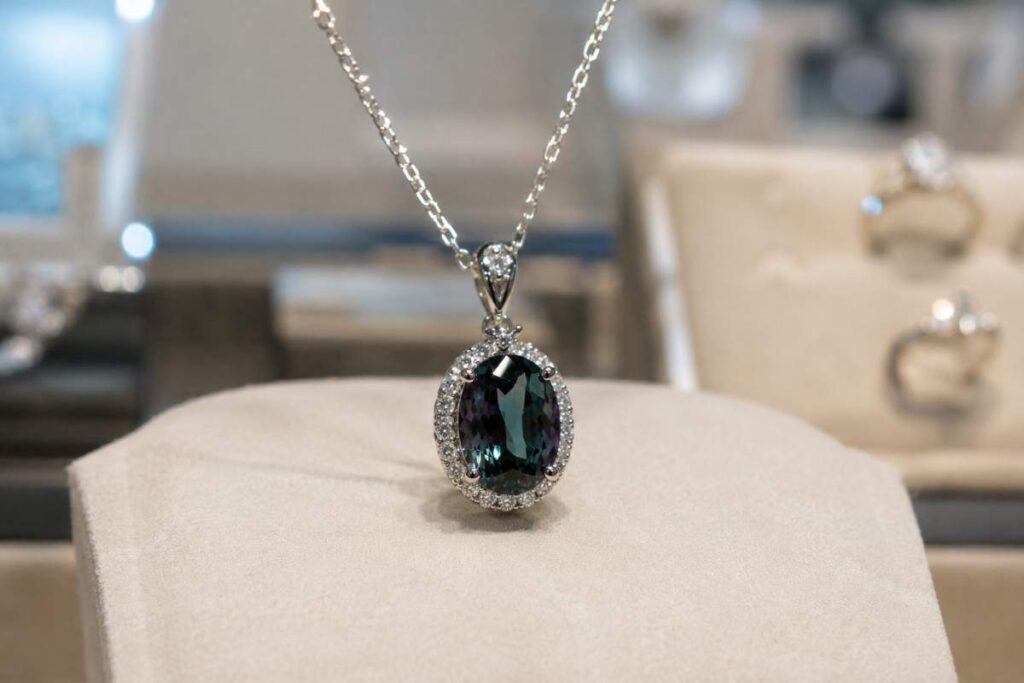
Choosing a lab-created stone is not a compromise; for most jewelry lovers, it is the only realistic choice. Real, earth-mined alexandrite is so incredibly rare that high-quality stones over one carat are practically impossible to find on the open market. When you do find one, the prices are staggering, often ranging from $10,000 to over $50,000 per carat depending on the clarity and the dramatic shift of the color change. For a daily wearable piece of jewelry like an engagement ring, buying a natural stone is simply out of financial reach for the vast majority of American couples.
Lab-grown alexandrite solves this problem without forcing you to settle for a cheap fake like glass or plastic. These are genuine alexandrite crystals grown in a controlled environment. They share the exact same chemical structure, physical durability, and stunning optical properties as mined stones. You get the famous “emerald by day, ruby by night” color shift on a highly durable gem that scores an 8.5 on the Mohs hardness scale—meaning it is perfectly suited to withstand the daily wear and tear of a modern lifestyle.
The real difference comes down to availability, pristine quality, and the price tag. Because a lab can consistently produce large, beautifully saturated, eye-clean stones, you can buy a breathtaking three-carat gem for a tiny fraction of what a microscopic, flawed natural stone would cost. Opting for a lab-created gem gives you the full luxury experience, stunning visual beauty, and ethical, eco-friendly peace of mind without requiring a literal fortune to own it.
Natural vs Lab-Created Alexandrite – How to Tell the Difference
Due to advanced technology, it is quite difficult to differentiate between Natural vs Lab-Created Alexandrite.
To tell them apart, look inside the stone first. Natural alexandrite grows underground over millions of years, leaving behind tiny internal flaws like microscopic crystals, gas bubbles, or fractures. Lab-grown stones are created in controlled environments, meaning they are either completely flawless or contain tiny curved lines and metal flecks from the lab equipment.
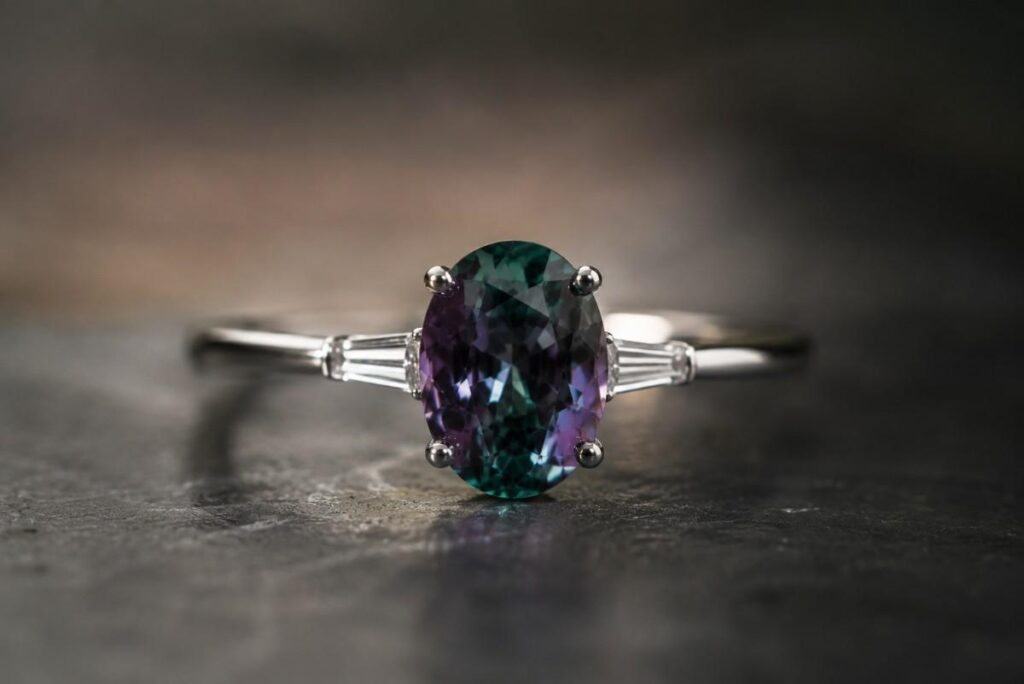
Next, pay close attention to how the stone changes color. Natural alexandrite shows a soft, elegant color shift, usually moving from a mossy green in daylight to a purplish-red under indoor light. Lab-created stones tend to have an over-exaggerated, dramatic shift, often snapping instantly from a bright blue-green to a vivid, unnatural purple.
Finally, the price and size will give it away immediately. Because natural alexandrite is one of the rarest gemstones on earth, large and clear stones are exceptionally expensive and hard to find. If you see a large, spotless alexandrite sold at an affordable price, it is undoubtedly lab-made. Genuine natural stones will always come with an official certificate from a respected gem laboratory to prove their origin.
Is Lab-Created Alexandrite “Real”? Here’s the Truth
Natural Alexandrites are rarely found in nature, which led to the making of lab-created Alexandrites. But here’s the truth, lab-created Alexandrites are as valuable as any other gemstones; however, it cannot be compared to the natural one. So, yes, lab-created Alexandrite are actually real because they share the same optical and color-changing properties known as “Alexandrite Effect”. Apart from this, they are created in labs using the same chemical ingredients under the same conditions as natural alexandrites – only much faster.
How to Take Care and Clean Your Alexandrite Birthstone
On the Mohs hardness scale Alexandrite is placed at 8.5, that means it is a stable gemstone which is a great choice for jewellery pieces like rings and pendants. Alexandrite is known for its beauty and rarity. Therefore, even a sturdy gemstone like alexandrite requires proper care and maintenance in order to last long.
Due to its hardness, it is scratch-resistant and can be worn everyday. However, it is important to note that like any other gemstone excessive heat, harsh chemicals, and sudden temperature changes can damage the stone and alter its visual properties. To clean Alexandrite, consider following these steps:
- Gentle cleaning – Take a bowl filled with lukewarm water and add mild soap to it. Soak the ring for 10-15 minutes and gently clean the ring with a soft toothbrush. Wash it thoroughly and pat dry with a soft cloth or a paper towel.
- Steam Cleaning – It uses hot water vapor to clean gemstones. Alexandrite is also generally safe for this method, as it is stable under normal heat conditions
- Ultrasonic Cleaning – This type of cleaning uses high-frequency sound waves in a liquid medium to loosen and remove debris.
Safety Precautions:
- If there are small fractures avoid ultrasonic or steam pressure as it can crack and damage the stone.
- If Alexandrite gemstone is set in a metal which can be damaged or softened by heat then you should avoid steam or ultrasonic cleaning.
- If possible remove the stone before cleaning it and
- If you are still in doubt take it to a jeweler to clean it for you.
Final Thoughts – A Stone as Layered as Your Are
Just like you, June’s signature birthstone refuses to have just one personality. Alexandrite’s ability to shift from a fresh green in the morning sun to a raspberry red under evening lights is a beautiful reminder that change isn’t just natural, it is beautiful also. This rare gem serves as a wearable mirror for your own personal journey, celebrating every mood, every breakthrough, and every multifaceted layer of who you are. It proves that you don’t have to stay locked in one box; you can adapt, evolve, and shine brightly through every single transition life throws your way.
Check out Lumus for more related posts.